Blog
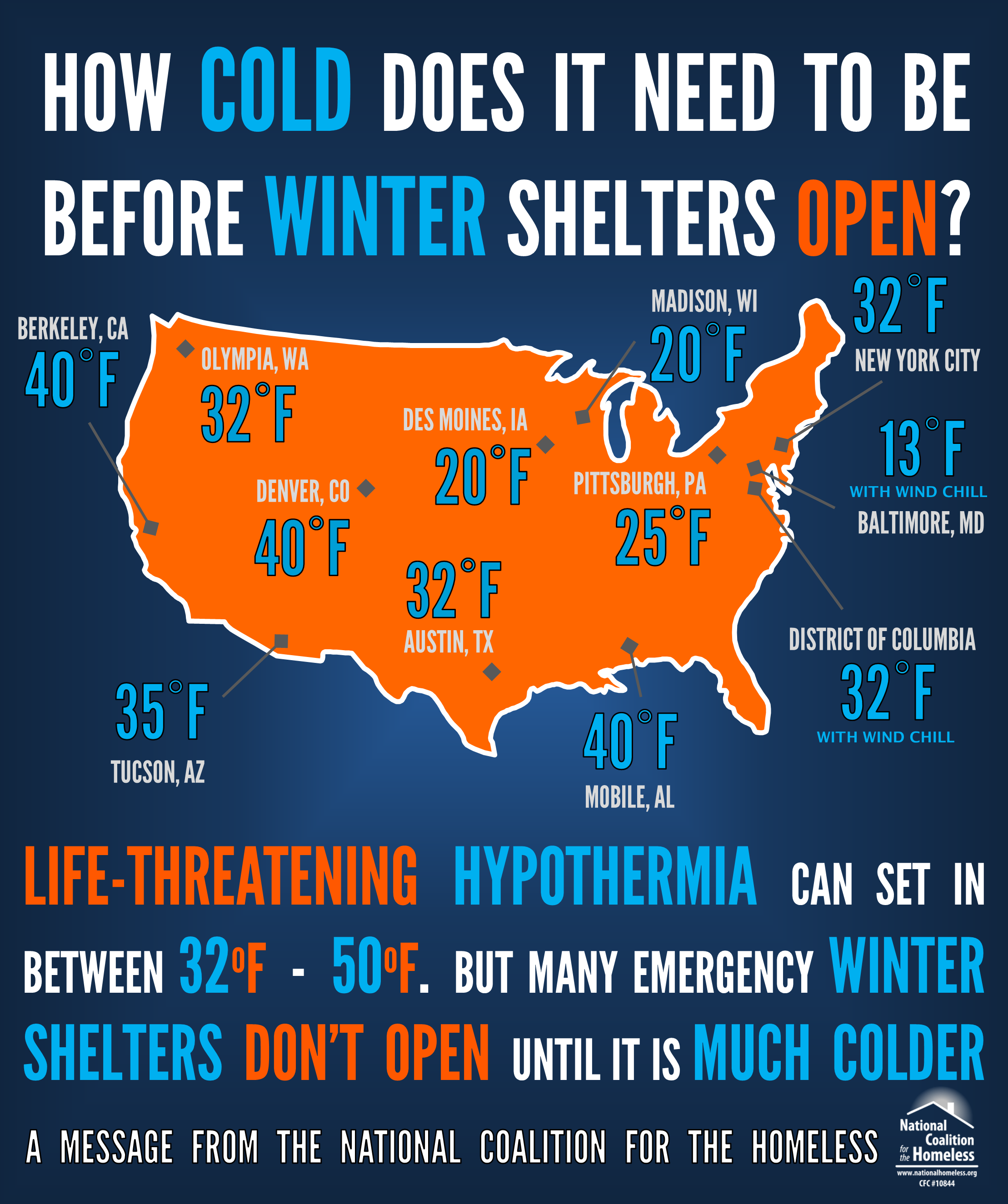
The shrinking number of affordable housing options has exacerbated issues of homelessness nationwide. To make matters worse, the severely cold winter weather, in addition to creating dangerous circumstances for the homeless, has restricted other options that families with inconsistent housing might have resorted to before.
Though the recommended amount to ensure housing affordability is 30 percent of one’s income, low-wage workers significantly exceed that amount. According to a study by The Joint Center for Housing Studies of Harvard University, for low-income renters with $15,000 in annual income, housing costs are considered affordable at $375 a month based on the 30-percent-income affordability standard; however, in 2013, the National Low Income Housing Coalition found that the national average monthly rent on a two-bedroom is $977, which leads more than 76 percent of renters in low-income households to spend over 50 percent of their income on just on housing costs.
States nationwide have also seen an increase in the cost of rental prices. The National Low Income Housing Coalition also determined the housing wage for a two-bedroom apartment, which is the hourly wage necessary to afford a modest rental unit (including rent and utilities). Based on that research, to live in the four states with the highest housing costs would require an average “housing wage” of $32.12 in Hawaii, $27.15 in the District of Columbia, $25.78 in California, and $25.25 in New York. In other words, to afford a two-bedroom apartment within these states, minimum wage workers must work more than 177, 132, 129, and 139 hours a week, respectively, which is dependent on the cost of living within those states.
Unfortunately, children are at the receiving end of this difficult situation. Families are faced with insurmountable barriers without housing and will have to make sacrifices related to their children’s school attendance, maintaining child care, and often times, maintaining their own employment. The lack of affordable housing has also forced families to “double- or triple up,” which often means multiple families cohabitating in a small space with limited privacy; leading to violations of public housing rules and even facing the threat of eviction. Without a consistent home and strong safety net programs to help in times of need, this situation places children in danger.
The issue of limited housing affordability has created a surge in the family homelessness population. For example, in Washington, DC, 1,000 new residents are moving in every month, but only 5,000 more units are built every year. Since real estate in DC has evolved into a lucrative market, poor families are sometimes pushed out of the city to where shelter or affordable housing are more readily available. The District has seen an increase of approximately 500 newly homeless families that have entered into emergency shelter, and that number is projected to double by the beginning of April. Families in Washington previously had the option of staying in D.C. General Shelter, an abandoned hospital turned into living space, described by residents in a Washington Post interview as having “sketchy water and rat infestation,” but space has been completely filled since last winter. As an alternative, families were then placed in motel rooms across Maryland and DC, though limited availability and political concerns over spending across jurisdiction, has ruled-out that option as a long-term solution.
Policymakers should consider long-term solutions in addressing the needs of homeless families. One of the most important long-term investments to reducing this problem is to support affordable housing. As we outline in our report on supporting affordable housing policymakers should:
1. Support the Development of Responsible Affordable Housing Options
- State and local policymakers should encourage the development of affordable housing by establishing housing trust funds that can ensure long-term flexible funding for affordable housing and housing services.
- Enabling and encouraging inclusionary zoning and supporting transit-oriented development can expand the affordable housing stock while contributing to housing equity, access to educational and employment opportunities, and sustainable community growth. A minimum percentage of each new housing development’s total units can be designated as affordable housing and remain that way for a set period of time, and in return, developers can receive cost offsets, such as relaxed zoning restrictions, and density bonuses.
- Utilizing the Low-Income Housing Tax Credit (LIHTC) can produce affordable housing since it is designed to be flexible with states being held responsible for establishing the program’s goals and the types of rental housing developed.
- Policymakers can encourage transit-oriented development by offering incentives for residential and mixed-use developments near transit stations, which can support affordability, economic development, mobility, and pollution reduction.
- Policymakers can also incentivize efforts to increase the energy-efficiency of existing properties and support new developments by using environmentally responsible development principles. Reducing the costs for energy, transportation, and water can help low-income families meet their needs while creating more environmentally responsible communities.
2. Strengthen Housing Programs
- State policymakers can help ensure access to decent, safe, and sanitary affordable housing in rural, suburban, and urban communities by providing a range of subsidized housing options and supporting housing maintenance, such as enhancing section 8 funding to include low- and moderate-income families with special needs and disabled and homeless families.
3. Provide Housing Protections for Low-Income Families
- State policymakers can support housing protections through rent regulation, reasonable code enforcement, tax relief, and eviction prevention.
4. Coordinate Access to Services and Support Asset Building
- State policies can provide low-income families with the opportunity to live in housing where services are accessible and well-integrated. Human service agencies can coordinate and streamline service provision for low-income households, supports should include opportunities to learn about asset building and affordable homeownership. Integrating services with affordable housing can help low-income families achieve housing stability.
Visit PolicyforResults for our web resource for more details on our policy recommendations for Promoting Affordable Housing.